Geology of Thought
Performance
March 14, 2026, 19:00 (pay as you wish)
HISTORY OF SCIENCE
aNOther festival, future art lab Klangtheater, mdw, 1030, Anton-von-Webern-Platz 1
W.A.L.Z. Performance collective (Karlheinz Essl, Markus Wintersberger, Andrea Nagl)
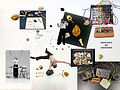
Drawing on the “geological revolution” – that moment when humans first began to grasp the depth (and continuity) of Earth history – Karlheinz Essl (sound), Andrea Nagl (dance, objects), and Markus Wintersberger (visuals) explore, in a performative installation, how thought, perception, and the body shift when time and matter are renegotiated.
“Getting one’s hands dirty” becomes a double image: a gesture of investigative proximity, echoing the early field geologists, and a contemporary call for a sensuous, co-responsible relationship with the Earth in the Anthropocene.
What once marked a scientific revolution becomes an artistic practice: tracing the thresholds between knowledge and sensation, research and touch.
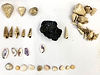
Sound, objects such as stones, sand, and fossils, text/language, movement, and projection become instruments of an embodied mode of thinking, unfolding into an atmospheric field of transformation.
Between field laboratory and stage, theory and tactility, an experimental space emerges in which knowledge sediments, categories shift, and thinking becomes corporeal.
A tentative inquiry into time, change, and our planet …
Chapter 1: Theology – The Closed Cosmos
Bishop Ussher, Creation, the Deluge.
Mathematics, Geometry, Philosophy – theoretical reasoning, calculation.
Wunderkammer / Cabinet of Curiosities – aesthetics before scientific inquiry.
Chapter 2: Reading in the Book of Nature – Into the Field
Leaving the study – venturing into the terrain.
The Neptunists: all rock precipitated from water.
Füchsel – the principle of strata, first geological profiles.
Abraham Gottlob Werner: primitive mountains and alluvial mountains.
Systematic observation. The earth as layered archive.
Chapter 3: Fossils – The Archives of Catastrophe
Cuvier – comparative anatomy, extinction, catastrophism.
Smith – mapping, strata, index fossils.
Collecting, cataloguing, classifying.
Fossils become the new structure of earth history.
Chapter 4: Deep Time – The Eternal Cycle
Uniformitarianism – the present as key to the past.
Hutton: no beginning, no end – the earth as perpetual cycle.
Lyell: slow, steady transformation – past and present united.
Playfair: the abyss of time.
Deep time – humanity grows small.


references:
Gottfried Hofbauer (2015): Die geologische Revolution. Wie die Entdeckung der Erdgeschichte unser Denken veränderte.
Schär, Kathrin (2021): Erdgeschichte(n) und Entwicklungsromane. Geologisches Wissen und Subjektkonstitution in der Poetologie der frühen Moderne.
Cuvier, Georges (1830): Die Umwälzungen der Erdrinde in naturwissenschaftlicher und geschichtlicher Beziehung.
Lyell, Charles (1830): Principles of Geology
Playfair, John (1802): Illustrations of the Huttonian Theory of the Earth
Ussher, James (1650): Annales Veteris Testamenti a prima Mundi Origine Deducti
Werner, Abraham Gottlob (1787): Klassifikation und Beschreibung der verschiedenen Gebirgsarten.