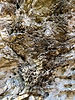
becoming [stone]
Performance
October 16 & 17, 2025
BITTESCH GNEISS, MICA SCHIST / PERNEGG GROUP
TANZ*HOTEL GAST*SPIELE Festival
Theater am Petersplatz, Vienna
Koproduktion AAR|T*H
concept&dance: Andrea Nagl, sound: Karlheinz Essl, costume: Sarah Sternat, light design: Veronika Mayerböck, geological support: Reinhard Roetzel
Restaging: April 23 + 24, das Margareten, Vienna
Between deep time and tectonic movement, between stone and memory, Andrea Nagl explores forms of embodiment: What happens when the body turns to sediment, when thought slows down, when time becomes matter?
Drawing on the medieval tale of Kidhy, geological field practices, and the realization that even solid rock is only a transitional state, her performance opens toward a “sense of stone” (Novalis) — a more-than-human attunement that rethinks the world beyond human-centered categories.
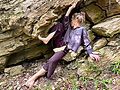
becoming [stone]
becoming [stone] explores the slow metamorphosis of matter — the transformation of rock through pressure, heat, dissolution, and reformation.
Stone never dies. It shifts, folds, melts, and reappears in another form. What we call “a rock” is only a fragment of a larger body — a mountain, a crust, a planet.
To hold a stone is to hold time itself.
It is a fragment of a former whole, a witness to tectonic movements, ancient oceans, vanished atmospheres.
Andrea Nagl’s work approaches geology as both science and embodiment.
Through movement and somatic attention, she investigates how geological processes — compression, erosion, crystallization — can be experienced through the body, as vibration, density, or inner duration.
Becoming stone is not imitation, but transformation: an act of radical empathy, a dissolution of boundaries between the human and the more-than-human.
In the slow temporality of rock, the body finds a counterpoint to the acceleration of the Anthropocene — an invitation to humility and kinship, to remember that we too are sediment, mineral, archive.
Matter does not disappear — it only changes state.
The same elements that form the mountains flow through our blood.
We eat stones, breathe the dust of eroded peaks, and will one day return to the sedimentary record.
To become stone is to recognize continuity, to feel time expand beyond the human pulse — a quiet, enduring conversation between body and planet.


Review von Ditta Rudle
“Die Eröffnung des Gastspiels dominierte Andrea Nagl mit ihrem als AAR im Herbst erarbeiteten Solo becoming (stone). (…) Vor der Pause zeigt die sensitive und immer wieder großartige Tänzerin Andrea Nagl ihr neues Solo becoming (stone) zu dem Karlheinz Essl die Musik komponiert hat und die Tänzerin live begleitet. Wenn der Stein, das Steinige, das Versteinern in Klammer steht, so darf angenommen werden, dass es auch ohne Ziel schlicht ums „Werden“, also das Verändern geht. Andrea Nagl fesselt mit intensiven Bewegungen, weich geschwungenen Armen und starker Präsenz. Die Bewegungen werden langsamer, oft sieht die Tänzerin ihre Hände und Arme zweifelnd an, als wüsste sie nicht, was mit ihnen geschieht. Essl elektronische Musik lässt an Natur denken und macht auch (was Andrea später erzählt), dass Steine gar nicht versteinert sind. In ihrem Inneren rumort es, Moleküle bewegen sich, chemische Vorgänge verändern den Stein. Eine Performance, die Schönheit und Tiefe zugleich zeigt und den menschlichen Körper in die Geologie einfügt.”
photo left: Background Andrea Nagl, stage: Hanna Fasching|Tanz*Hotel|Bildrecht
photos below: Markus Wintersberger

Restaging April 2026, das Margareten - picture left: Sara Wilnauer-Leitner


references:
Bernroider (1989): Zur Petrogenese präkambrischer Metasedimente und cadomischer Magmatite im Moravikum
Egli (1971): Gespräch mit der Natur
Erzählung des Kidhy, Aus: Muhammad al-Qazwīnī: Die Wunder der Schöpfung und die
Merkwürdigkeiten der vorhandenen Dinge, um 1270 (pdf von Reinhard Roetzel)
Frasl (1991): 3.1. Das Moravikum der Thaya-Kuppel als Teil der variszisch deformierten Randzone des Bruno-Vistulikums
Fuchs/Matura (1976): Zur Geologie des Kristallins der südlichen Böhmischen Masse
Höck/Marschallinger/Topa (1990): Granat-Biotit-Geothermetrie in Metapeliten der moravischen Zone in Österreich
Höck (1991): 3.2. Das Moravikum der Thaya-Kuppel in Österreich - Lithologie und Metamorphose
Roetzel/Fuchs (2008): Erläuterungen zu Blatt 8 Geras
Roetzel (2010): Geologie und Geomorphologie im Nationalpark Thayatal-Podyjí
Zalasiewicz (2010): The planet in a pebble